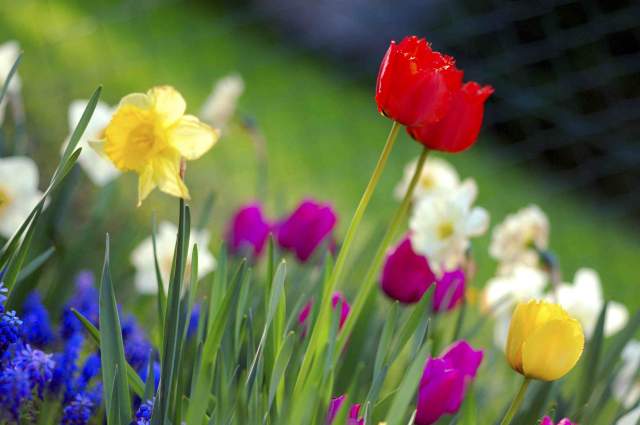
YAY!
It's our favorite time of the year! Spring is here!

Spring's around the corner - time to get real about decluttering your mind and your lawn.
Before you begin your Spring lawn service, be sure to get as clean of a grassy surface as possible. Remove all leaves, sticks and other debris from your grass. Leaves that have been left on top of your lawn prevent proper drainage and can lead to decay. Two things that aren't helpful to a beautiful, healthy lawn.
But, compost leaves and other organic debris allow you to benefit twice:
1. You get a greener, healthier lawn.
2. Your lawn has extra nutrients for the Spring season.
So, time to head out and start collecting!
At Natural Turf, we care about three things: your lawn, your family and your health. But, one thing that we also always keep in mind is how our products are safer for preserving natural wildlife and their habitats. And so should you.
Beyond Pesticides has a wonderful fact sheet that outlines many of the real dangers of chemical fertilizers and pesticides.
Some highlights:
1. Studies find that dogs exposed to herbicide-treated lawns and gardens can double their chance of developing canine lymphoma and may increase the risk of bladder cancer in certain breeds by 4-7 times.(1)
2. Of the 30 commonly used lawn pesticides: 16 are toxic to birds, 24 are toxic to fish and aquatic organisms and 11 are deadly to bees.(2)
3. Pesticides can be toxic to wildlife and cause food source contamination, behavioral abnormalities that interfere with survival, and death.(3)
4. Lawn and garden pesticides are deadly to non-target species and can harm beneficial insects and soil microorganisms essential to a naturally healthy lawn.(4)Let's respect wildlife and go natural. The way nature intended.
Sources
1. Glickman, Lawrence, et al. 2004. "Herbicide exposure and the risk of transitional cell carcinoma of the urinary bladder in Scottish Terriers." Journal of the American Veterinary Medical Association. 224(8):1290-1297; Haynes, H., et al. 1991. "Case-control study of canine malignant lymphoma: positive association with dog owner's use of 2, 4-D acid herbicides." Journal of National Cancer Institute. 83(17): 1226.
2. Beyond Pesticides Factsheet. 2005. Environmental Effects of 30 Commonly Used Lawn Pesticides.
3. Defenders of Wildlife. The Dangers of Pesticides to Wildlife. April 2005.
4. Restmeyer, S. J. 2003. Ecological Pest Management: Embracing the Organic Approach to Landscape Management. Pesticides and You. 23(1): 11-12. Beyond Pesticides. Washington, DC.
We're getting there...the sun's peeking through...
Mowing is one of the most important activities in maintaining your lawn. Regardless of whether your lawn is fertilized, irrigated or receives applications of control products, proper mowing practices are essential. Properly mowed lawns will have fewer weed populations, better moisture stress tolerance and generally better quality than improperly mowed lawns. Plus, they look spiffy-er, too. Low heights have limited leaf area to sustain photosynthesis rates to maintain good plant vigor. In addition, your grass will develop a stronger root system.
For more info, checkout this great fact sheet from The Ohio State University. How do you mow for a great-looking lawn?
Grass is a great air conditioner in summer and heater in winter. They stay at the nice temperate ranges of 50-75 degrees even when sidewalks and streets are as hot and cold as 100-30 degrees.Pretty cool (or hot), huh? Happy weekend!

OK, OK, the lawn care season is getting closer! :)
So, what now? Get ready for the season by getting a soil test. You should never spend any money on any fertilizer or soil amendment without first checking out the results of a soil test first.
All lawn care fertilizers are comprised of three main ingredients:
1. Nitrogen - Helps keep your grass healthy, vibrant green and helps keep it nice and thick! A healthy lawn can naturally ward of bugs and pests, too.
2. Phosphorous - Nutritionally helps strong roots in your grass.
3. Potassium - It also bolsters the strength of your blades, which helps your lawn weather particularly dry or hot spells.
When choosing the right fertilizer, you want to get the right combination of these three key nutrients to the soil at a rate that's optimal for growth. You also want to mind your budget, personal time investment (like hiring a pro).
Whatever your path, testing your soil first and selecting a fertilizer with the optimal makeup of the three key nutrients will give you the best shot to a more emerald, stronger and fuller lawn you can be proud of.